


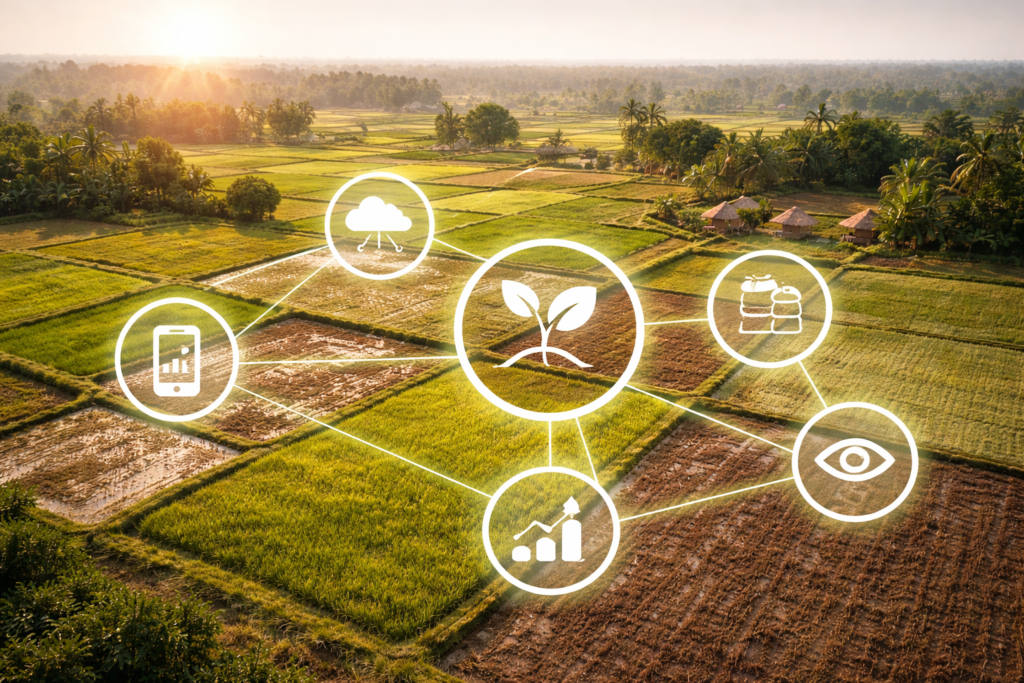
The agriculture sector often talks about the future in terms of products.
New hybrids.
New technologies.
New inputs.
But the next decade of agri distribution will not be defined by what is sold.
It will be defined by what is owned.
And ownership, in this context, does not mean inventory.
It means outcomes.
The Subtle Shift Already in Motion
Across regions, something quiet is happening.
- Farmers are becoming less patient with uncertainty
- Input costs are rising faster than margins
- Climate variability is compressing decision windows
In response, the ecosystem is being forced to confront a question it has long avoided:
Is selling a seed enough, if the outcome is unpredictable?
The answer, increasingly, is no.
Why the Old Playbook Is Reaching Its Limits
The traditional distribution model was designed for a different era:
- predictable seasons
- stable rainfall patterns
- low data availability
- limited accountability beyond sale
In that world, success was measured by:
- reach,
- volume,
- and speed.
But when variability increases, speed without suitability becomes a risk.
The same playbook now amplifies error instead of absorbing it.
Outcomes Are Becoming the New Currency
In the coming decade, agri systems will be evaluated less on availability and more on reliability.
This changes the basis of competition.
The shift looks like this:
- From selling inputs → to reducing uncertainty
- From moving inventory → to stabilising results
- From transaction completion → to seasonal accountability
Outcomes become the differentiator – not claims.
Why This Is Harder Than It Sounds
Designing outcomes is not about better advice.
It’s about system redesign.
Because outcomes depend on:
- soil intelligence,
- timing precision,
- context-aware recommendations,
- and continuous feedback.
No single player can do this in isolation.
This is why the future does not belong to:
- standalone dealers,
- disconnected marketplaces,
- or siloed technologies.
It belongs to ecosystems.
The Rise of the Ecosystem Model
Ecosystems don’t just distribute.
They coordinate.
They align:
- data with decisions,
- incentives with outcomes,
- and accountability with visibility.
In an ecosystem model:
- information doesn’t stop at dispatch,
- learning loops survive the season,
- and mistakes don’t repeat silently.
This is not about control.
It’s about coherence.
The Strategic Advantage of Early Adopters
Seed companies that adapt early gain something difficult to replicate later:
institutional learning.
When outcomes are tracked:
- recommendations improve,
- trust compounds,
- and product strategy becomes evidence-driven.
Late adopters don’t just lose time.
They lose context.
And in agriculture, context is not transferable overnight.
Why This Transition Is Inevitable
Three forces make this shift unavoidable:
- Climate volatility reduces tolerance for error
- Rising costs increase the price of mismatch
- Data availability raises expectations of accountability
When these forces converge, outcome-blind systems struggle to survive.
Not because they lack intent –
but because they lack structure.
What “Designing Outcomes” Actually Means
Designing outcomes does not mean guaranteeing yield.
It means:
- reducing avoidable loss,
- narrowing variability,
- and owning the decision logic behind recommendations.
It’s the difference between:
“We sold the seed”
and
“We understand why this outcome occurred.”
That understanding becomes the foundation for trust.
Where Krishipath Fits in This Future
Krishipath is not being built to replace the existing system.
It is being built to connect what the system has kept apart:
- soil and seed,
- decision and outcome,
- recommendation and responsibility.
The goal is not disruption for its own sake.
It is designing coherence where fragmentation has been normalised.
The Question the Next Decade Will Ask
As agriculture moves forward, one question will quietly separate leaders from participants:
Who stays with the farmer after the seed is sold?
Those who do will shape the next decade.
Those who don’t will keep competing on availability.
And availability, in a volatile world, is no longer enough.
Closing Note
The next decade of agri distribution will not reward those who sell the most.
It will reward those who understand outcomes the best.
And understanding, once built into a system, becomes a competitive advantage that doesn’t fade with seasons.